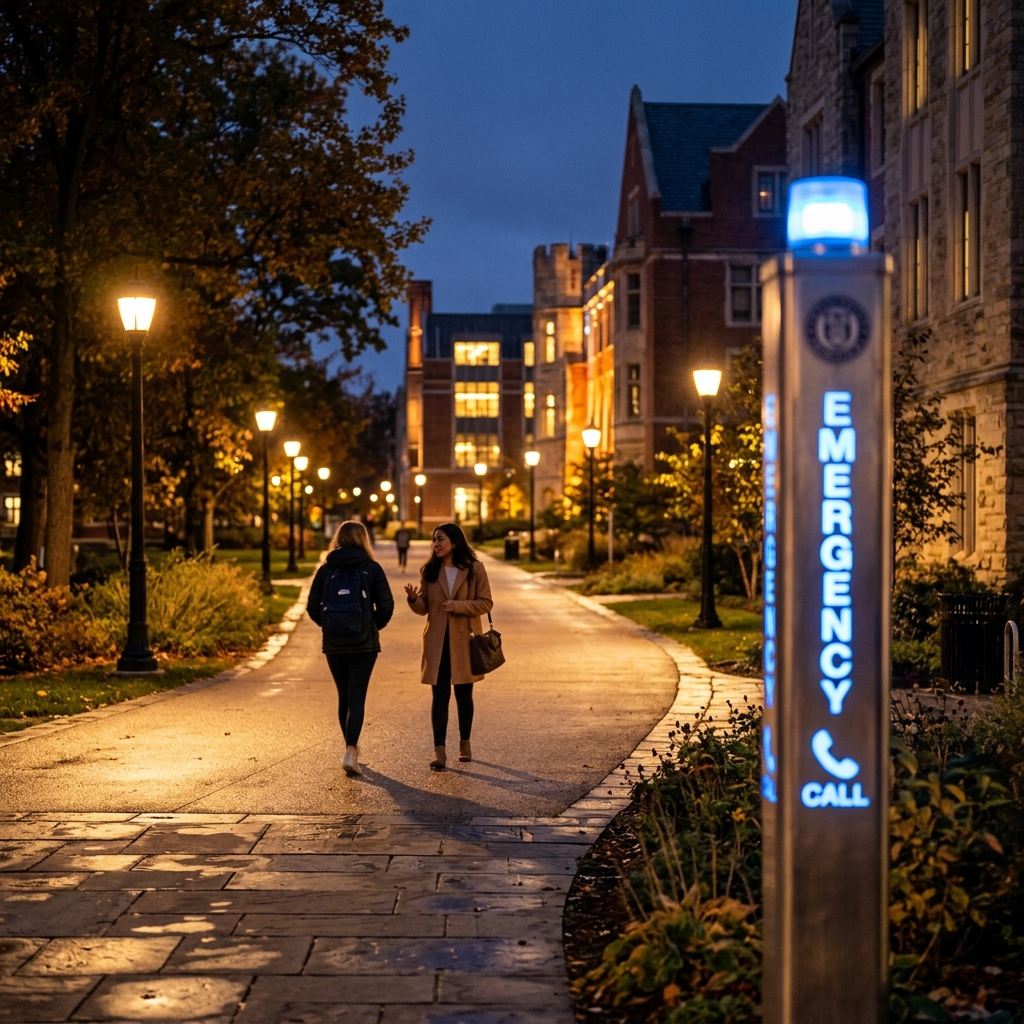
University campus walkway at twilight with emergency call station
The Labora Collective · Clinical Reference

Sexual Assault Prevention and Resources on Campus

Knowing your options before you need them.

Content Note: This article discusses sexual assault, trauma, and institutional response. It uses trauma-informed language and centers survivor agency. If you or someone you know needs immediate support, RAINN is available 24/7 at 1-800-656-4673.

Sexual assault on campus is not an accident of bad luck or bad decisions — it is a predictable outcome of how American institutions distribute power, accountability, and silence. When a student is harmed at a university, the question that follows them is not "how do you get justice" but "which of these systems do you have the energy to fight." Knowing the answers before you need them is not pessimism. It is preparation.

This is meant as orientation. It is not a substitute for an advocate, a clinician, or an attorney.

Who actually has authority on a campus

Sexual assault response on a college campus runs through three parallel systems that often do not coordinate, sometimes contradict each other, and almost never have the same purpose:

The campus Title IX office. Title IX is the federal civil rights law that prohibits sex discrimination at any school that takes federal money. The Title IX office is responsible for investigating reports involving students. Its outcomes are administrative — suspension, expulsion, no-contact orders. It is not a courtroom.

Campus security or local police. Criminal reporting goes through law enforcement. The standard of proof is higher and the timeline is longer. Many survivors who file with Title IX never file criminally; many who file criminally never file with Title IX. They are different processes with different goals.

The campus health and counseling center, plus any confidential advocate the school employs. These are the routes where a student can talk about what happened without triggering an investigation. Confidentiality matters here because it determines who can keep your information private and who is legally required to escalate it.

A piece of advice that should be plainly stated: who is required to report what depends on the school and the role. A faculty member you trust may be a mandatory reporter. A counselor at the campus mental health center usually is not. A residential advisor often is. If you are not sure whether the person you are about to talk to is required to report, ask first.
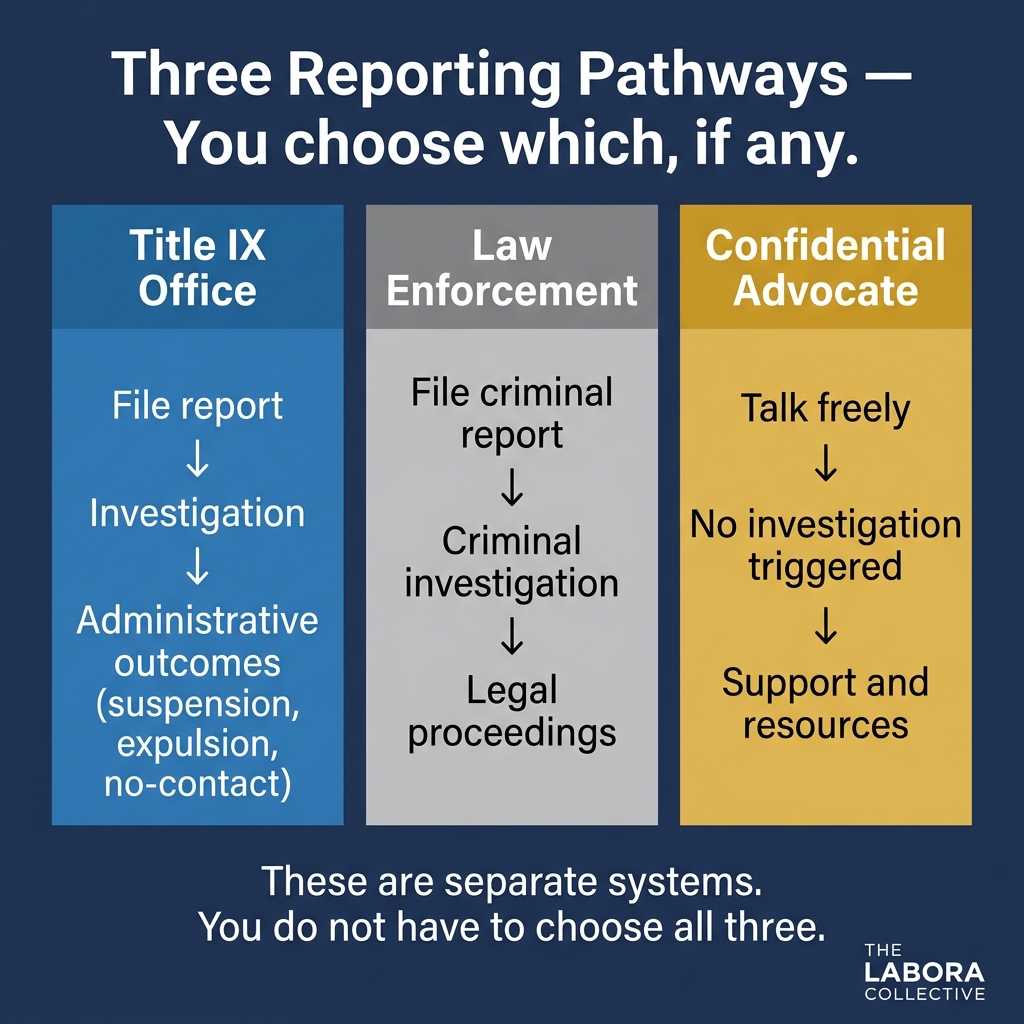
Three parallel reporting pathways: Title IX Office, Law Enforcement, and Confidential Advocate
Figure 1 — Three reporting pathways. These are separate systems with separate purposes. Survivors choose which, if any, to engage.

Medical care after an assault

The clinical priority in the first seventy-two hours is to preserve the option of medical treatment and evidence collection — whether or not the survivor has decided to file any report.

Care at this stage typically includes:

A medical exam, ideally with a Sexual Assault Nurse Examiner (SANE), who is trained in both forensic evidence collection and trauma-informed care. SANE exams are available at designated hospitals; many campuses do not perform them on-site.

Emergency contraception, if relevant. This should be offered without barrier.

Post-exposure prophylaxis for HIV, which is time-sensitive — it works best when started as soon as possible and is much less effective after the first seventy-two hours.

Testing and prophylactic treatment for other sexually transmitted infections.

Pregnancy testing, if relevant.

Forensic evidence can be collected during a SANE exam and held for a period defined by state law without a survivor having to decide, in that moment, whether to file a report. If a survivor is unsure, the exam preserves the option.

Prevention messaging that focuses on what a student wore, drank, said, or texted is not prevention — it is post-hoc blame management.

What "prevention" really means

The interventions that actually move outcomes are structural:

Bystander training that gives specific scripts and specific actions.

Clear, public, accessible reporting pathways with named people responsible.

Sanctions that the institution actually enforces, predictably.

Real housing alternatives — moving the survivor is not a remedy; the school should be able to move the person who caused harm.

Confidential medical and counseling resources that do not require a police report as a gatekeeper.

If a campus says it cares about prevention and the only thing it offers is a freshman orientation slideshow about consent, the campus does not care about prevention.

What survivors are entitled to ask for

Your Rights

  • A no-contact order between the survivor and the person they have named.
  • Schedule, dorm, or class accommodations so the survivor is not forced to share space with the named student.
  • A confidential advocate who is not the Title IX investigator and is not on the institution's side in any proceeding.
  • A copy of any final report the institution produces, including findings and rationale.
  • Information about what is being shared with whom, including parents, faculty, and police.
  • Reasonable academic accommodations — incomplete grades, deadline extensions, withdrawal from a course without academic penalty.

These are not favors. They are policy.

Where the system breaks

Investigations are slow, sometimes outlasting the survivor's enrollment.

Outcomes are inconsistent across cases, depending on the named student's standing, athletics affiliation, or family contributions to the school.

Confidential advocates are underfunded — at many institutions, one part-time person covers thousands of students.

Mandatory reporting can pull survivors into processes they did not choose and were not warned about.

Survivors of color, queer survivors, and survivors with disabilities are less likely to be believed, more likely to be questioned about their own behavior, and less likely to see institutional outcomes that match their stated harm.

None of this is hidden. The data exists. Institutions choose what to do with it.
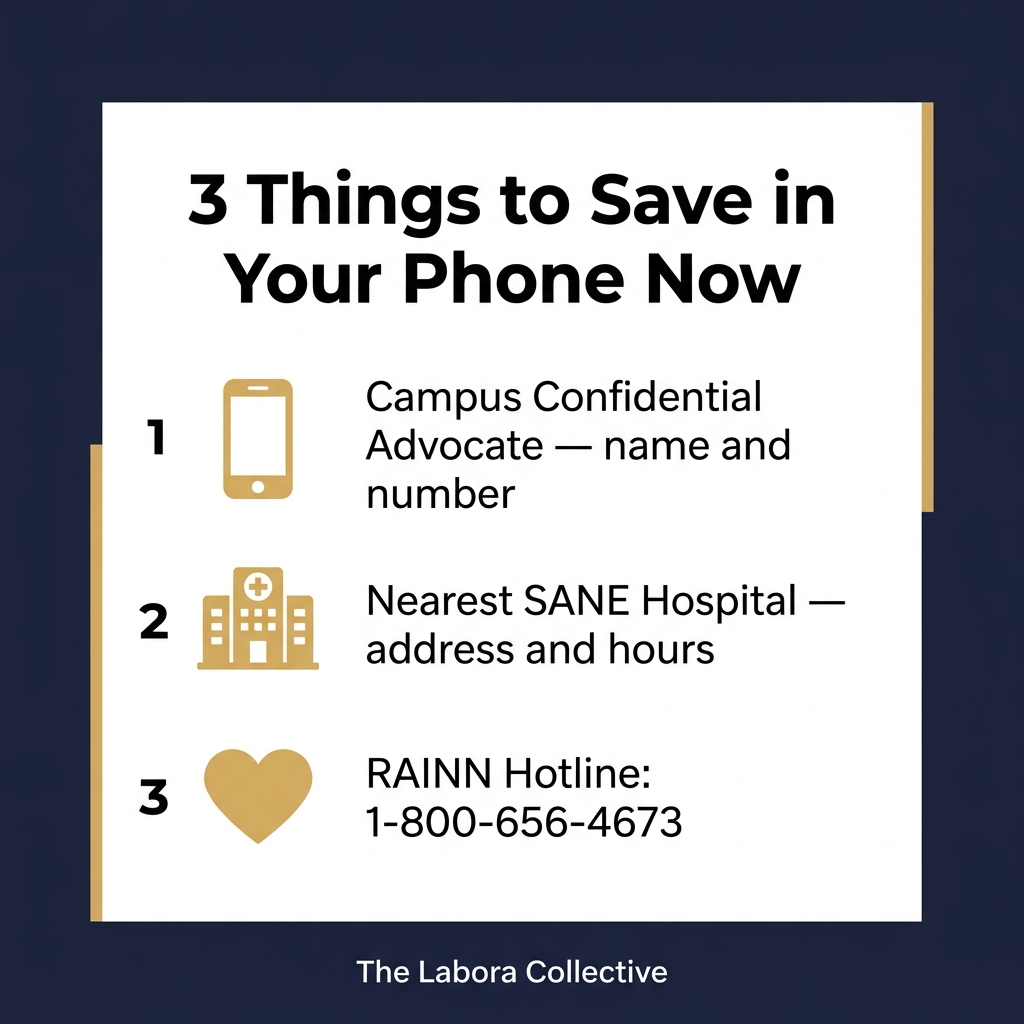
Infographic: 3 Things to Save in Your Phone Now — Campus Confidential Advocate, Nearest SANE Hospital, RAINN Hotline
Figure 2 — Save these three things before you need them.

What to do now, before anything happens

Three concrete steps that do not require anything to have occurred:

Find your campus confidential advocate. Save the phone number. Confirm that they are confidential and do not have a mandatory reporting role.

Identify the nearest hospital with a SANE program. Confirm whether your campus transports.

Look up your school's Title IX policy. Read the sections on supportive measures, no-contact orders, and confidentiality.

You will hopefully never need any of this. If you do, you will not be in the cognitive state to research it from scratch.

Campus sexual assault is a public health problem and a civil rights problem and an institutional accountability problem at the same time. Treating it as only one of those produces interventions that do not work. The job of a clinician, an advocate, or a peer is not to coach a survivor through optimism — it is to make the systems legible, to make the survivor's options real, and to refuse to disappear when the institution would prefer the case to go quiet.

Patient Guide — What to Know and Do

If something has happened

  • Get to a safe place and contact someone you trust.
  • Seek medical care — a SANE exam within 96 hours preserves the most options.
  • You do NOT have to decide about reporting right now.
  • Contact your campus confidential advocate BEFORE Title IX if you want to understand options without starting an investigation.

Medical care includes

  • Physical exam and injury treatment
  • Emergency contraception
  • HIV post-exposure prophylaxis (most effective within 72 hours)
  • STI testing and prophylactic treatment
  • Pregnancy testing

Three things to save now

  • Campus confidential advocate: _______________
  • Nearest SANE hospital: _______________
  • RAINN 24/7 Hotline: 1-800-656-4673

If you are a parent: have this conversation before orientation, not after.

Provider Scripts — Clinical Setting

Initial Disclosure Response "Thank you for telling me. I believe you. What happened to you is not your fault. Nothing happens next without your input."
SANE Referral "I'd like to connect you with a Sexual Assault Nurse Examiner. Having the exam does not commit you to filing a report — it preserves the option. The window is 96 hours."
Mandatory Reporting Transparency "Before we go further — in my role, I am [a mandatory reporter / not a mandatory reporter]. That means [I must share certain information with Title IX / what you tell me stays between us]. I want you to know that before you decide what to share."
Follow-Up Care "How is your housing? Are you able to attend classes? Do you have someone safe to talk to? These are part of your care, not extras."
When Patient Declines to Report "That is entirely your right. Not reporting does not change the care you are entitled to."

Red Flags for Clinician Screening

  • Unexplained injuries, STI, or pregnancy with avoidance during history
  • Asks about confidentiality before disclosing
  • Sudden academic decline, sleep disruption, social withdrawal
  • Screen: "Has anyone hurt you or forced you to do something you didn't want to?"

Social Media Assets

Pull quote cards, infographics, and carousel slides — ready to download and post.

Audio Script — Podcast Read

Welcome to The Labora Collective. Today: sexual assault prevention and resources on campus.

Most students never expect to need a campus crisis line. That is exactly why the information in this piece needs to live in your phone before it needs to live in your memory.

Campus sexual assault response runs through three parallel systems — Title IX, law enforcement, and confidential health and counseling — that often do not coordinate. Each has a different purpose. Each has a different threshold for action. Survivors are not required to choose all three. They are not required to choose any.

Here is what every student, parent, clinician, or RA should know: First, find your campus confidential advocate and save that number. Second, identify the nearest hospital with a SANE program. Third, read your school's Title IX policy — the sections on supportive measures and confidentiality.

You will hopefully never need any of this. If you do, you will not be in the cognitive state to research it from scratch.

The full reference guide — including a patient handout, provider scripts, and all resources — is available at laboracollective.com. If you or someone you know needs immediate support, RAINN is available twenty-four seven at 1-800-656-HOPE.

This has been The Labora Collective. Thank you for listening.

Estimated read time: 2 minutes 15 seconds · Recommended voice: measured, clinical, warm

Video Storyboard

Short-form educational video (60–90 seconds) for Instagram Reels / TikTok / YouTube Shorts.

Scene 1 — Hook
Text on screen over campus B-roll
Text overlay: "3 things every college student should save in their phone before orientation week." Slow pan of campus walkway at twilight. Ambient audio, no narration yet.
0:00 – 0:08
Scene 2 — The Problem
Statistics appear as text
Text builds: "1 in 5 women. 1 in 16 men. Reporting rates: under 20%." Cut to empty lecture hall. Voiceover: "Campus sexual assault response runs through three systems that often don't coordinate."
0:08 – 0:20
Scene 3 — The Three Systems
Animated flowchart appears
Reporting Pathways infographic animates in column by column — Title IX, Law Enforcement, Confidential Advocate. Voiceover explains each in one sentence. "These are separate. You choose which, if any."
0:20 – 0:40
Scene 4 — The Three Things
Phone screen mockup
Camera pushes in on phone screen. Three contacts being saved: 1. Confidential Advocate, 2. SANE Hospital, 3. RAINN. Each appears with a satisfying "save" animation. "Save these now. Before you need them."
0:40 – 0:55
Scene 5 — Closer
Pull quote + CTA
Black screen, white text: "You will hopefully never need any of this. If you do, you will not be in the cognitive state to research it from scratch." Labora Collective logo. "Full guide — link in bio."
0:55 – 1:05
Production Notes
Technical Specs
Aspect: 9:16 (vertical). Color grade: desaturated, warm. Music: ambient, low-key (no upbeat). Captions: burn-in, white on dark, sans-serif. No faces needed — B-roll and text-driven.
Total: ~65 seconds

Resources

RAINN
1-800-656-4673 · rainn.org
National Sexual Assault Hotline — 24/7, confidential
Crisis Text Line
Text HOME to 741741
24/7 crisis counseling via text message
National Sexual Violence Resource Center
nsvrc.org
Research, tools, and training materials
Know Your IX
knowyourix.org
Student-led Title IX advocacy and education
End Rape on Campus
endrapeoncampus.org
Policy reform and direct support for survivors
SANE Facility Finder
forensicnurses.org
Locate the nearest forensic nursing program
Love Is Respect
1-866-331-9474 · loveisrespect.org
Dating abuse hotline for young people